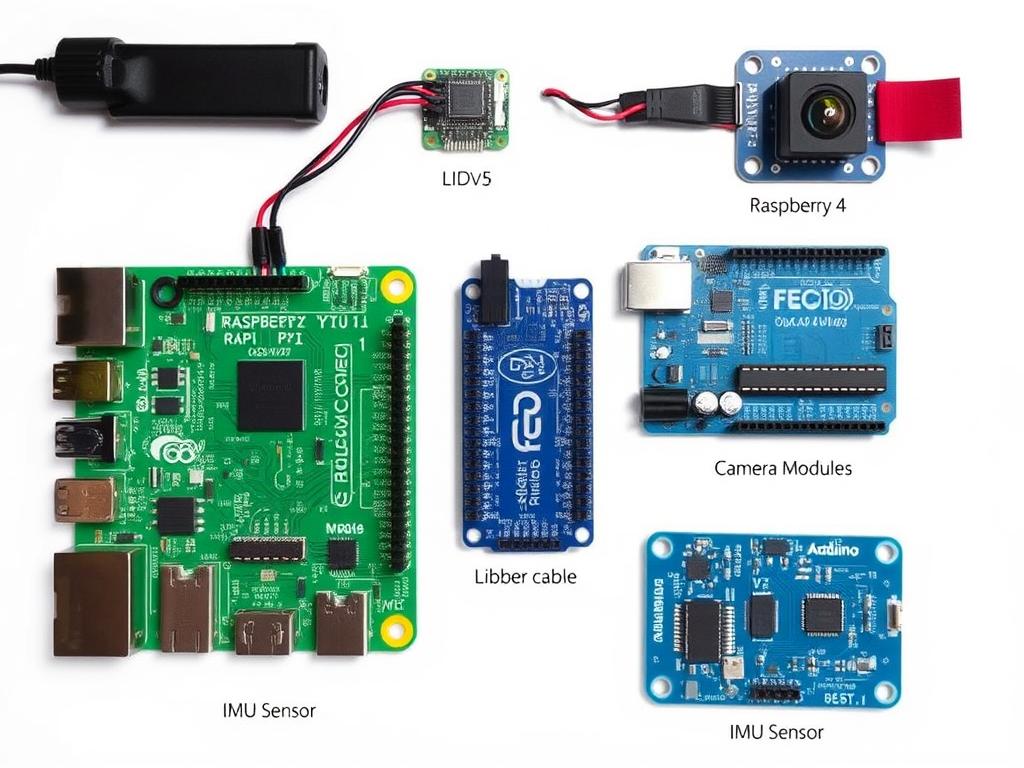
The Image Shows A Set Of Electronic Devices And Sensors Commonly Used In IoT And Machine Learning Hardware
The image shows a set of electronic devices and sensors commonly used in IoT and machine learning hardware setups. Here’s a breakdown: Raspberry Pi 4 (green board on the left): A small single-board computer with multiple ports (USB, HDMI, Ethernet) and a GPIO (General Purpose Input/Output) header for connecting sensors and modules. It’s used for running object detection models like YOLOv5 and handling real-time processing. Arduino Uno (blue board in the center-right): A microcontroller board with digital and analog I/O pins. It’s often used to interface with hardware sensors such as LIDAR, thermal sensors, accelerometers, and gyroscopes. Camera Modules (top and right): Two different types of cameras are visible. One is a small module connected via jumper wires (likely a standard camera sensor), and another is a ribbon-cable-based camera (similar to a Raspberry Pi Camera Module), used for capturing real-time video/images for object detection. IMU Sensor (bottom small blue board): This looks like a 9-axis IMU (Inertial Measurement Unit) containing an accelerometer and gyroscope, useful for detecting movement, tilt, and vibrations on railway tracks. LIDAR/Thermal Module (top small module next to Arduino): A compact sensor that could represent a LIDAR or thermal imaging sensor for detecting obstacles or heat signatures (like animals).
02.10.2025 18:21
Related Images