Ultra-Detailed Scene Description Scene Composition The Dragonborn Is Placed Directly Beside The Ruined
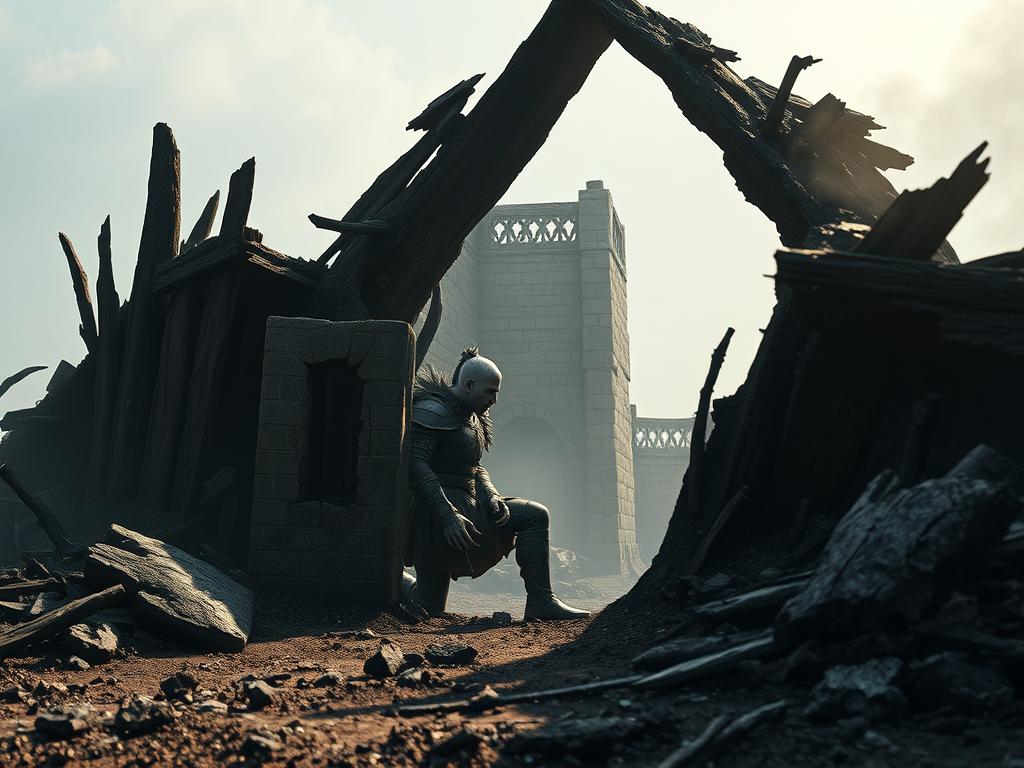
Ultra-Detailed Scene Description Scene Composition The Dragonborn is placed directly beside the ruined structure, not behind it or partially obscured, but standing or kneeling so close that the shattered remains almost brush against his armour. The ruin occupies the entire foreground, dominating the frame with immediate visual weight. Instead of melting into the landscape, it rises up around the character as a stark, physical presence — splintered beams, collapsed stone, and drifting ash forming a jagged border that frames him almost like a broken shrine. His pose conveys quiet intensity. In the kneeling variant, he lowers one knee into the ashy earth, one clawed hand gently resting upon a burnt beam. His fingers press into its surface, sinking slightly into the brittle charcoal, suggesting both reverence and grief. In the standing variant, he remains tall and still, with the ruin resting at his flank, his body angled so that pieces of collapsed wall form a diagonal behind him. His silhouette cuts through the smoky light, his posture controlled but heavy with reflection. The scale of the ruin is imposing. Massive beams lie collapsed in a tangled pattern, forming natural arches and troughs of shadow. Portions of stone wall still stand but only as fractured teeth of masonry, leaning inward or outward at precarious angles. These remnants frame the Dragonborn physically and thematically — he is held within the ribs of something destroyed, marked by the remnants of conflict or tragedy. 🏚️ Ruin Details (Hyper-Specific) Charred beams: Long, splintered timbers jut outward at different angles, each one blackened to matte charcoal. Some pieces show deep fissures where heat has cracked the wood, while others are coated in a flaky grey ash. Their ends are jagged, as if snapped by force rather than decay. Collapsed stone walls: The rubble forms uneven mounds, with pieces ranging from fist-sized chunks to monolithic slabs. The edges of the stone are rough and fractured, bearing scorch marks and smoke smudges. In some areas, the walls still cling together in partial segments, leaning like exhausted giants resisting collapse. Ash and embers: A thin veil of ash carpets the ground, disturbed where the Dragonborn stands or kneels. Tiny red-orange embers still glow in sheltered crevices, suggesting the ruin burned very recently. Wisps of heat haze rise from them, distorting the air in gentle ripples. Foreground focus: The ruin is rendered with sharp, almost tactile clarity. Every crack, grain of ash, and fragment of stone is lit with crisp contrast so it unmistakably occupies the front of the composition. This ensures the structure feels immediate and unavoidable rather than distant scenery. 🌅 Atmosphere (Deeply Expanded) Lighting: A warm, fading sunset glow sweeps across the scene, painting the broken timbers in golds, ambers, and muted reds. The low angle of the sun casts elongated shadows that stretch across the rubble, emphasizing the irregular geometry of destruction. Smoke particles catch the light in drifting currents, turning them into thin ribbons of copper and rose. Mood: The overall tone is solemn, reflective, and heavy with quiet meaning. The Dragonborn is not shown as enraged or triumphant but as a calm witness to loss. His posture and the slow, ember-lit environment convey a moment of introspection — a warrior pausing amid devastation not to fight, but to remember. The blend of warm sunset and cold ruin creates emotional tension: beauty overlaying destruction, resilience emerging within the remnants.
08.12.2025 17:33
Related Images